


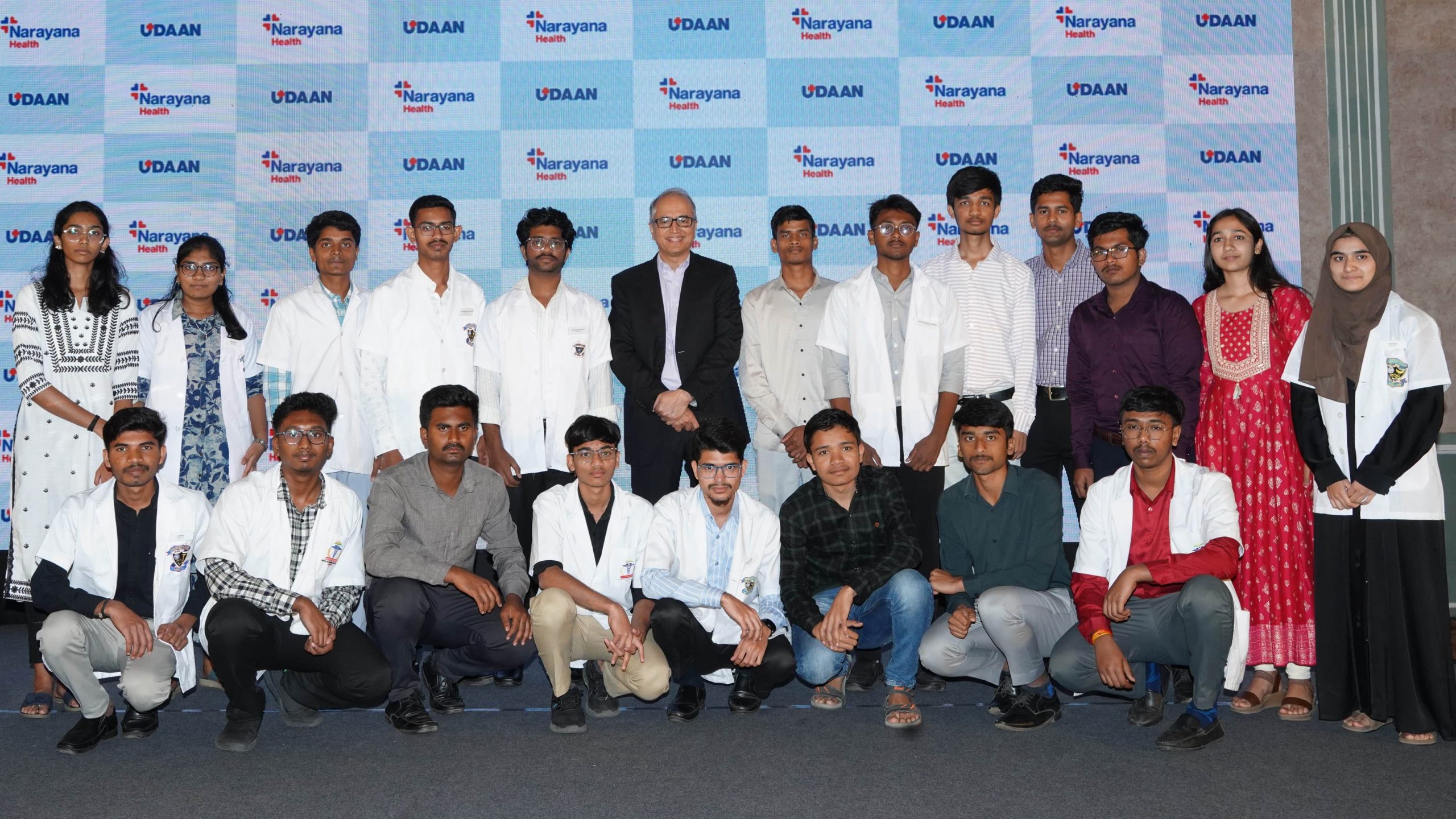
 Bengaluru: Narayana Health announced the continued expansion and impact of its Udaan initiative, a long-term programme designed to strengthen India’s healthcare workforce by enabling meritorious students from economically modest backgrounds to access medical, nursing, and paramedical education in government institutions. Through structured guidance and financial support, the initiative helps students secure seats in government colleges and pursue sustainable careers in healthcare—contributing directly to strengthening India’s healthcare ecosystem and improving the country’s doctor-to-population ratio over the long term. As part of the initiative, Dr Devi Shetty, Founder and Chairman, Narayana Health, felicitated Udaan-supported students who are progressing into Government medical and nursing careers, highlighting the programme’s growing impact.
Despite advances in healthcare infrastructure, India’s doctor-to-population ratio—officially estimated at around 1:811—continues to mask a deeper imbalance in the availability of trained medical professionals across the country. The challenge is most acute in rural and underserved regions, where the ratio drops as low as 1:2,700 in some states. Guided by Dr Devi Shetty’s vision, Udaan addresses this gap at its root by supporting talented students from underserved backgrounds to pursue formal medical education, strengthening healthcare availability where it is needed most.
Dr Devi Shetty, Founder and Chairman, Narayana Health, said, “India’s healthcare future depends on our ability to narrow the gap between the number of doctors and the patients who need care. Through Udaan, we are supporting talented young people who may not otherwise have had the opportunity to pursue medical and nursing education. When these students go on to serve regions where access to doctors remains limited, the impact extends far beyond individual success—it strengthens the healthcare system and improves access to care for communities across the country.”
 During the engagement, Dr Devi Shetty interacted with NEET Scholars, MBBS scholarship beneficiaries and NEET aspirants currently supported under the programme. Students from humble socio-economic backgrounds—many of whom will be first-generation doctors or nurses in their families—shared reflections on their academic journeys, mentorship support, and the role of structured guidance in shaping careers focused on serving communities with limited access to healthcare.
Launched in 2014 in Karnataka, Udaan has evolved into a multi-state initiative spanning in eight States. To date, the programme has supported over 1,500+ NEET aspirants, 1200+ MBBS students, and 600+ nursing students. The programme was also known as Udayer Pathey (On the path of Rising/Awakening) in West Bengal, where it actually began in 2008 and later came to a common name as “Udaan”
In FY 2024–25 alone, Udaan supported 800+ MBBS students across 15 government medical colleges and 800+ nursing students across 13 nursing colleges, with 53 per cent female participation among NEET aspirants, underscoring its role in expanding access and inclusion in medical education.
The programme’s outcomes reflect its growing impact at scale. During the 2024–25 academic year, Udaan supported 36 students securing admission to AIIMS, while four students joined Lady Hardinge Medical College. Of the 475 students supported, 205 gained admission to government medical colleges across 30+ Government institutions nationwide, including AIIMS Delhi, AIIMS Nagpur, Bangalore Medical College, Mysore Medical College, and Atal Bihari Vajpayee Medical College, Bengaluru. Over the past three years, 360+ Udaan scholars have joined government medical colleges, contributing directly to India’s future healthcare workforce. The average cost of training one doctor under the programme stood at ₹50,400 for FY 24-25, demonstrating the efficiency and scalability of the model.
As India continues to navigate rising healthcare demand and workforce shortages, initiatives such as Udaan demonstrate how sustained, education-led interventions can play a critical role in building a more accessible, resilient, and equitable healthcare system for the future.